Electric Again
Table of Contents
Dedicated to the memory of David Andersson, whose lyrics and soaring guitar work on Soilwork’s “Electric Again” from the album Övergivenheten serves as a powerful reminder of the energy and spark required to keep moving forward. He passed away on September 14, 2022, but the voltage he left behind remains.
The Mystery of Electricity #
Most of the time, we treat electricity like magic. You flip a switch on the wall, and the room fills with light. You plug a heavy, silent box into an outlet, and suddenly it’s humming, calculating millions of numbers a second, and rendering pixels on a monitor screen.
But it isn’t magic. It is just a highly organized, completely invisible migration. To really understand what electricity is clearly, without the confusing jargon, we have to zoom in. Way, way in. Past the copper wire, past the rubber insulation, all the way down to the fundamental building blocks of the universe: atoms.
The Restless Outer Rim: Electrons #
Imagine an atom as a tiny solar system. At the very center, you have the “sun” which is the nucleus, made of heavy protons and neutrons tightly bound together. Orbiting around this nucleus, like tiny hyperactive planets, are the electrons.
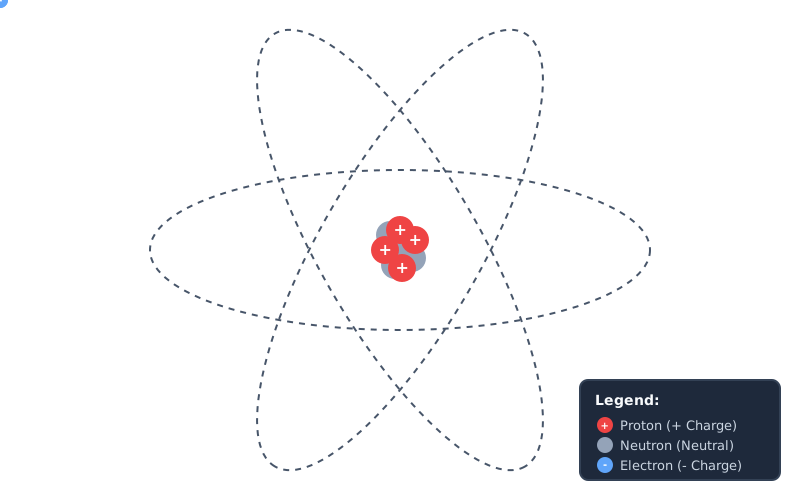
Nature is lazy. It likes balance. The positive charge of the nucleus usually holds onto the negative charge of the orbiting electrons perfectly. If you look at something like a piece of rubber or wood, those atoms are holding onto their electrons with an iron grip. Nobody is allowed to leave orbit.
But conductive metals like copper, gold, and silver are different. Their outer structure is loosely organized. The outermost electrons sit alone in loosely held orbits, practically begging to leave. They are restless, constantly wandering over to visit the neighboring copper atoms.
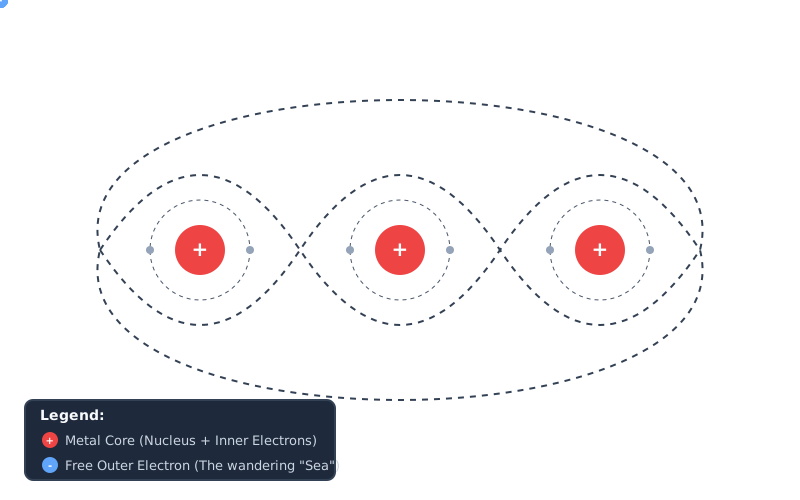
In a standard copper wire sitting on your desk, there are trillions of these loose electrons just milling around randomly, trading places with each other. But because they are moving in every random direction at once, nothing actually happens.
Electricity is simply the act of giving all those wandering electrons a reason to march in the exact same direction.
Volts: The Invisible Push #
How do we get them to march? We have to apply pressure. In electricity, we call this pressure Voltage.
Think of a water tower. If you have a massive tank of water sitting 100 feet in the air, gravity is pulling down on it, creating immense pressure in the pipes below. The water wants to escape. The higher the tower, the greater the pressure.
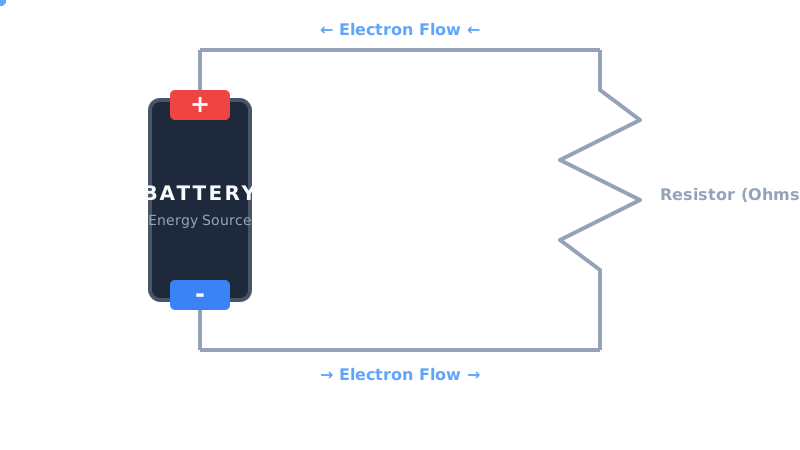
A battery or a generator does the exact same thing, but with electrons. A battery uses an internal chemical reaction to build up a massive excess of electrons at the negative terminal, and a severe shortage at the positive terminal.
Because electrons all have a negative charge, they absolutely hate being near each other. They repel one another violently. So when you cram trillions of them into the negative side of a battery, they are screaming to get away from each other and return to the positive side where there is room. That intense, pent-up desire to escape is Voltage.
When you connect a copper wire between the two ends of the battery, you suddenly provide an escape route. The pressure forces the loose electrons in the copper to start shoving each other down the line.
Amps: The Great Migration #
Once the electrons start moving through the wire, we measure how much traffic is actually flowing. We call this flow Current, measured in Amperes (or Amps).
If Voltage is the water pressure in a pipe, Amps measure how wide the pipe is and how many gallons of water are rushing past you every single second.
A static shock from a doorknob has incredibly high voltage (maybe 20,000 Volts.) The pressure is huge but practically zero Amps. Barely any electrons actually make the jump, and the charge is entirely depleted in a fraction of a millisecond. That moment where you think, “Wait, 20,000 volts didn’t kill me?!” is because the volume of the flow was almost nonexistent. It stings, but it’s harmless.
A car battery, on the other hand, only has 12 Volts, very low pressure, but it can deliver hundreds of Amps. It’s like a slow-moving, massively wide river of electrons, packing enough volume to forcefully crank a heavy steel engine block.
Ohms: The Friction in the Pipe #
But there is a third piece to this puzzle. The wire isn’t a perfect, frictionless water slide. As electrons push through, they bump into the atoms of the material. We call this electrical friction Resistance, measured in Ohms.
If Voltage is the pressure and Amps are the flow, Resistance is the narrowness of the pipe. A giant fire hose lets water flow easily (low resistance). A tiny cocktail straw fights the flow (high resistance).
When electrons are forced through a high-resistance material, that electrical friction creates heat. This is exactly how an old-school incandescent light bulb works. The electricity flows easily through the low-resistance copper wire in your wall, but then it hits the tiny, highly resistant tungsten filament inside the bulb. The electrons squeeze through, creating so much friction and heat that the metal literally glows white-hot.
Watts: Doing the Actual Work #
So we have pressure (Volts) pushing the flow (Amps) against the friction (Ohms). To figure out the total amount of work the electricity is actually doing, we calculate the power. We call this total power Watts.
The relationship is elegantly simple:
Watts = Volts × Amps
Imagine you want to use water to spin a heavy waterwheel. You could use a tiny hose with incredibly high pressure, or you could use a massive, slow-moving river. Both could spin the wheel at the exact same speed, delivering the exact same amount of total power (Watts).
When you look at a household appliance and it says it draws 60 Watts, it means the high-pressure voltage from your wall is pushing against the specific resistance of that appliance, resulting in a flow of amps that perfectly calculates to 60 watts of energy consumed.
The Spark of Life #
When you strip away the math, electricity is just energy looking for equilibrium. It is the orchestrated movement of the smallest pieces of the universe, doing the heavy lifting of the modern world. It is raw, invisible kinetic energy, flowing through silicon and copper to bring cold metal to life.
It is how we light our homes, how we calculate the cosmos, and when you plug in a guitar and strike a chord, it is the exact mechanism that takes the vibration of a steel string and makes it electric.